Friday, August 8, 2008

Caesarea


Located about 30 miles north of Tel Aviv and 20 miles south of Haifa, Caesarea was once a substantial and important Mediterranean seaport. It was also the provincial headquarters of Roman administration and the residence of Pontius Pilate, the Roman procurator.

The site was used as an anchorage since the 4th century B.C.E., but it was not extensively developed until Caesar Augustus presented it to Herod the Great in 30 B.C.E. Herod embarked on an ambitious building program and named the city Caesarea Maritima in honor of the emperor. Among the construction activities: an artificial harbor that provided anchorage for more than 100 ships; a large theater; a hippodrome; an amphitheater; a temple to Augustus; a main thoroughfare 18 feet wide; even a sewage system flushed by seawater.


In the 3rd century C.E. the writer Origen founded a Christian library and center of learning in Caesarea. Eusebius, one of Origen’s pupils, became bishop here in 314. At the height of the Byzantine Period the city rivaled Jerusalem in size.


Muslims captured Caesarea in 640 but did not make much use of it. The Crusaders began some rebuilding when they took the town in 1101, but they lost it to Saladin in 1187. In 1251 the French king Louis IX financed some reconstruction, but when the French Crusaders were expelled after just a few years, Caesarea was destroyed, and it remained unoccupied until 1878, at which time the Turks permitted reinhabitation of the site by refugees from Bosnia. This community abandoned the city in 1948 upon the establishment of the state of Israel. Only recently have excavations been started and the site developed into a tourist attraction.

The first stop on our tour to Caesarea was the theater, which can seat 4,000 persons; at the time of our visit, the stage was being set up for a concert that evening.


At the entrance to the theater were these sculptures, including this carved foot; one of the stones found here bore a Latin inscription that said, “Pontius Pilate, Prefect of Judea, made and dedicated the Tiberieum to the Divine Augustus”—this is important archaeological confirmation of the gospel accounts.


Our next stop was the palace area, where Herod had constructed a fine bath—actually, what appeared to be an enormous saltwater swimming pool! Nearby are the ruins of the temple (below right) that he built to honor the emperor.


The hippodrome (below), just inland from the bath, is an enormous arena where chariot and horse races were held.


As at most of the historic sites, there are some very fine mosaic floors in Caesarea.

This room is among the remains of some of the Crusader constructions, part of either a small chapel or a fortress.


Close by are these very fine statues, which were recently excavated. They are part of a Byzantine street and date from the 2nd or 3rd century C.E. These statues are quite impressive in execution and very large; the darker one is thought to depict Roman Emperor Hadrian and to have been carved in Egypt.


Not far away is the Roman aqueduct that supplied fresh water to Caesarea from Mount Carmel more than 12 miles away. The aqueduct was built of limestone, which is very porous, so the water channels were plastered to keep the water from seeping out. The portion of the aqueduct that we viewed, at the shore, was built at the beginning of the 2nd century C.E. under Hadrian’s rule (76-138 C.E.). It is now quite picturesque.


Caesarea is an important Christian site because it was here that Saint Peter baptized Cornelius, a Roman centurion, the first gentile to convert to belief in Christ. Saint Paul was also imprisoned in Caesarea for two years before being sent to trial in Rome. See Acts 8:40, Acts 10, Acts 21:8ff, and Acts 23-26 for references to Caesarea.

Monday, August 4, 2008

Tabgha and the Miracle of the Loaves and Fishes


15Toward evening the disciples approached him. "We're out in the country and it's getting late. Dismiss the people so they can go to the villages and get some supper."
16But Jesus said, "There is no need to dismiss them. You give them supper."
17"All we have are five loaves of bread and two fish," they said.
18-21Jesus said, "Bring them here." Then he had the people sit on the grass. He took the five loaves and two fish, lifted his face to heaven in prayer, blessed, broke, and gave the bread to the disciples. The disciples then gave the food to the congregation. They all ate their fill. They gathered twelve baskets of leftovers. About five thousand were fed.
--Matthew 14:15-21 (The Message)

After taking the boat across the Sea of Galilee, we visited the area of Tabgha, which is about 8 miles from Tiberias. The word tabgha is possibly a misappropriation of the Greek words hepta pegon, which mean "seven springs," and there are still seven springs nearby.

There are two main attractions in Tabgha: the Church of the Multiplication and the Church of Mensa Christi; we were able to visit only the former, which commemorates the "miracle of the loaves and fishes"--that is, the occasion when Jesus fed five thousand people with only five loaves of bread and two fish (see the Gospel of Matthew 14:15-21).


Upon viewing the countryside, it's easy to see why the disciples were so concerned: there were a lot of people--more than the entire populations of many towns combined--and it was a long way back to their homes across some pretty rugged and sparse terrain. After night fell there would have been no hope of anyone making it back to their own bed.


Interpretations of the miracle differ: some say that the baskets used to distribute the food were miraculously replenished; others take the "stone soup" perspective and hold that Jesus's example inspired the people to share the food they were carrying, so that all would have something; still others assert that the story is an allegory indicating how Jesus fed the people's spirit with what he said and what he did.

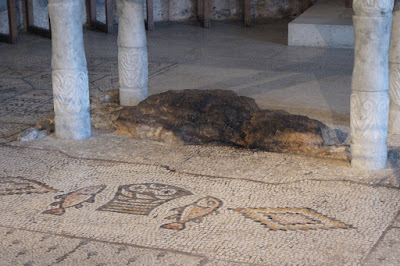
The Church of the Multiplication is a modern structure, built in 1984 on the site of the original fourth-century church. The main attraction is the wonderful fifth-century mosaic located in front of the main altar. This mosaic depicts a basket of bread loaves flanked by two fish.


In addition, the large stone beneath the altar is, according to tradition, the spot where Jesus placed the fish and bread when he blessed them.


Much of the floor consists of exquisite fifth-century mosaics. There are ducks, geese, herons, cranes, cormorants, peacocks, rabbits, and swans, in addition to wonderful geometric designs.


The sanctuary is small and, at times, crowded, but time allowing, one can sit and ponder the meaning of this gospel story. The cloister leading to the sanctuary is quite peaceful and provides a space for further meditation.

Saturday, August 2, 2008

Morning at the Sea of Galilee


Here's a hymn for morning that reminded me of our journey down to the Sea of Galilee and our crossing from Tiberias to Tabgha:

Not here for high and holy things we render thanks to thee,
but for the common things of earth, the purple pageantry
of dawning and of dying days, the splendor of the sea,

the royal robes of autumn moors, the golden gates of spring,
the velvet of soft summer nights, the silver glistering
of all the million million stars, the silent song they sing,

of faith and hope and love undimmed, undying still through death,
the resurrection of the world, what time there comes the breath
of dawn that rustles through the trees, and that clear voice that saith:

Awake, awake to love and work! The lark is in the sky,
the fields are wet with diamond dew, the worlds awake to cry
God's blessings on the days of life, as we dance lightly by.

Come, let thy voice be one with theirs, shout with their shout of praise;
see how the giant sun soars up, great lord of years and days!
So let the love of our God come and set thy soul ablaze,

to give and give, and give again, what God hath given thee;
to spend thyself nor count the cost; to serve right gloriously
the God who gave all worlds that are, and all that are to be.
--adapted from a hymn by Geoffrey Anketel Studdert-Kennedy
The Sea of Galilee is in the north of Israel, and it is a lovely place. Also known today as Lake Kinnereth, it is referred to in the gospels as the Sea of Tiberias as well as Lake Gennesaret. It is a large body of water, about 15 miles long and 8 miles wide, and it is deep, about 160 feet; surprisingly, it is about 650 feet below sea level. The Jordan River flows into the lake from the north and flows out to the south. Along the shores are the villages of Tiberias, Magdala, Tabgha, and Capernaum, which were all along the major trade routes running east to west.
According to the gospel accounts, the area around the Sea of Galilee was the location of much of Jesus' ministry. On the shores of this lake, Jesus called most of his disciples to follow him; most of them made their living as fishermen. He preached to the crowds from a boat anchored just a little way out on the water, and the hill where he preached the Sermon on the Mount is close by. Tradition indicates that he performed a number of miracles here, including quieting the storm and multiplying the loaves and fishes, and told many parables to his followers.
As the photos show, it is a really beautiful place; the countryside is rugged and arid, but vegetation flourishes along the shore, and fish are still quite abundant.
Irrigation is a great boon to agriculture, of course, and the modern Israelis have definitely "made the desert bloom." Just look at these limes ...

and unusual flowers ...

and pomegranates ...

It was really amazing to be able to cross these waters and walk these hills. It is a place of such tranquillity and beauty that in the stillness I could feel the Divine presence. We were blessed to have had this experience.