Monday, August 4, 2008

Tabgha and the Miracle of the Loaves and Fishes


15Toward evening the disciples approached him. "We're out in the country and it's getting late. Dismiss the people so they can go to the villages and get some supper."
16But Jesus said, "There is no need to dismiss them. You give them supper."
17"All we have are five loaves of bread and two fish," they said.
18-21Jesus said, "Bring them here." Then he had the people sit on the grass. He took the five loaves and two fish, lifted his face to heaven in prayer, blessed, broke, and gave the bread to the disciples. The disciples then gave the food to the congregation. They all ate their fill. They gathered twelve baskets of leftovers. About five thousand were fed.
--Matthew 14:15-21 (The Message)

After taking the boat across the Sea of Galilee, we visited the area of Tabgha, which is about 8 miles from Tiberias. The word tabgha is possibly a misappropriation of the Greek words hepta pegon, which mean "seven springs," and there are still seven springs nearby.

There are two main attractions in Tabgha: the Church of the Multiplication and the Church of Mensa Christi; we were able to visit only the former, which commemorates the "miracle of the loaves and fishes"--that is, the occasion when Jesus fed five thousand people with only five loaves of bread and two fish (see the Gospel of Matthew 14:15-21).


Upon viewing the countryside, it's easy to see why the disciples were so concerned: there were a lot of people--more than the entire populations of many towns combined--and it was a long way back to their homes across some pretty rugged and sparse terrain. After night fell there would have been no hope of anyone making it back to their own bed.


Interpretations of the miracle differ: some say that the baskets used to distribute the food were miraculously replenished; others take the "stone soup" perspective and hold that Jesus's example inspired the people to share the food they were carrying, so that all would have something; still others assert that the story is an allegory indicating how Jesus fed the people's spirit with what he said and what he did.

The Church of the Multiplication is a modern structure, built in 1984 on the site of the original fourth-century church. The main attraction is the wonderful fifth-century mosaic located in front of the main altar. This mosaic depicts a basket of bread loaves flanked by two fish.


In addition, the large stone beneath the altar is, according to tradition, the spot where Jesus placed the fish and bread when he blessed them.


Much of the floor consists of exquisite fifth-century mosaics. There are ducks, geese, herons, cranes, cormorants, peacocks, rabbits, and swans, in addition to wonderful geometric designs.


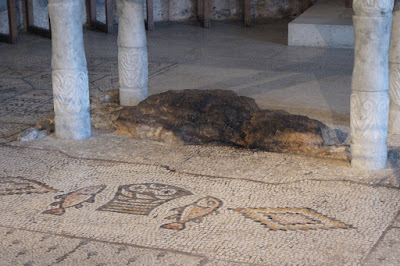
The sanctuary is small and, at times, crowded, but time allowing, one can sit and ponder the meaning of this gospel story. The cloister leading to the sanctuary is quite peaceful and provides a space for further meditation.

Saturday, August 2, 2008

Morning at the Sea of Galilee


Here's a hymn for morning that reminded me of our journey down to the Sea of Galilee and our crossing from Tiberias to Tabgha:

Not here for high and holy things we render thanks to thee,
but for the common things of earth, the purple pageantry
of dawning and of dying days, the splendor of the sea,

the royal robes of autumn moors, the golden gates of spring,
the velvet of soft summer nights, the silver glistering
of all the million million stars, the silent song they sing,

of faith and hope and love undimmed, undying still through death,
the resurrection of the world, what time there comes the breath
of dawn that rustles through the trees, and that clear voice that saith:

Awake, awake to love and work! The lark is in the sky,
the fields are wet with diamond dew, the worlds awake to cry
God's blessings on the days of life, as we dance lightly by.

Come, let thy voice be one with theirs, shout with their shout of praise;
see how the giant sun soars up, great lord of years and days!
So let the love of our God come and set thy soul ablaze,

to give and give, and give again, what God hath given thee;
to spend thyself nor count the cost; to serve right gloriously
the God who gave all worlds that are, and all that are to be.
--adapted from a hymn by Geoffrey Anketel Studdert-Kennedy
The Sea of Galilee is in the north of Israel, and it is a lovely place. Also known today as Lake Kinnereth, it is referred to in the gospels as the Sea of Tiberias as well as Lake Gennesaret. It is a large body of water, about 15 miles long and 8 miles wide, and it is deep, about 160 feet; surprisingly, it is about 650 feet below sea level. The Jordan River flows into the lake from the north and flows out to the south. Along the shores are the villages of Tiberias, Magdala, Tabgha, and Capernaum, which were all along the major trade routes running east to west.
According to the gospel accounts, the area around the Sea of Galilee was the location of much of Jesus' ministry. On the shores of this lake, Jesus called most of his disciples to follow him; most of them made their living as fishermen. He preached to the crowds from a boat anchored just a little way out on the water, and the hill where he preached the Sermon on the Mount is close by. Tradition indicates that he performed a number of miracles here, including quieting the storm and multiplying the loaves and fishes, and told many parables to his followers.
As the photos show, it is a really beautiful place; the countryside is rugged and arid, but vegetation flourishes along the shore, and fish are still quite abundant.
Irrigation is a great boon to agriculture, of course, and the modern Israelis have definitely "made the desert bloom." Just look at these limes ...

and unusual flowers ...

and pomegranates ...

It was really amazing to be able to cross these waters and walk these hills. It is a place of such tranquillity and beauty that in the stillness I could feel the Divine presence. We were blessed to have had this experience.

Our Lady of Lourdes and Padre Pio


Continuing with my reading of Padre Pio's letters, I happened across this passage in which he talks about Lourdes:

"I believe it is God's will for you to go to visit the beautiful Virgin of Lourdes....For many years I too have been longing to go there, but I am aware that this will never be anything more than a pious desire. I would ask you not to let slip this wonderful opportunity that heaven offers you, not to fail to put into effect this most holy sentiment and give free play to your devotion. Go there indeed, I beseech you, to visit the White Lady and pray to her for the needs of holy Church. Pray in a special way for my own wretched soul that it may never again be unfaithful to its God and pray for all those who are dearest to me. Lay at the feet of this most holy Mother an aspiration of mine. Oh! If only I could follow you in this visit, how fortunate I should be and what a wonderful favour from heaven would be mine! But may the Lord's will be done."
--from his letter to Raffaelina Cerase of July 28, 1914

Unfortunately, I've never had the opportunity to visit Lourdes--at least not yet. Perhaps someday. In the meantime, here is some additional information about the apparition of the Blessed Mother to Bernadette.

Her Story:
In the foothills of the Pyrenees in southwestern France lies Lourdes, one of the world's greatest pilgrimage sites. But in 1858, when the Blessed Mother first appeared to the peasant girl Bernadette Soubirous, Lourdes was a small village of no import.

On February 11 of that year, Bernadete went with her sister and friend to look for firewood. Upon reaching a nearby river, Bernadette heard a rushing sound; she turned to the grotto behind her and saw a beautiful lady dressed in white beckoning to her. After Bernadette prayed the rosary, the vision disappeared.


Bernadette returned to the grotto three days later and fell into a rapture when the lady appeared again. None of the other children was able to see the vision.
On February 18 the lady asked Bernadette to continue to visit the grotto. And this she did, accompanied by more and more of the villagers, who were curious about what might be taking place there.
On February 25 the lady directed Bernadette to go and drink from and wash herself in the spring; she then indicated a dry spot of land. In the presence of about 350 jeering witnesses, Bernadette began to dig in the dirt and "drink" the mud; then becoming aware of what was happening, she retreated in humiliation.
The lady did not return the next day, but Bernadette noted that water was issuing from the place where she had been digging. Nevertheless, the authorities continued to order her not to visit the grotto; she disregarded their commands.
On March 1 a pregnant woman dipped her paralyzed arm into the waters now flowing from the spring Bernadette had uncovered. Her cure was immediate and complete, and news of the miraculous spring began to spread.
When Bernadette told her parish priest of the lady's desire to have a chapel built near the grotto, he told her to ask the lady for her name. This Bernadette did on March 25, and the lady replied, "I am the Immaculate Conception." Having never before heard these words, Bernadette repeated them to the priest, who finally believed that the Blessed Mother had been appearing to Bernadette at the grotto.
Since March 1, 1858, millions of people hoping for healing have traveled to Lourdes to bathe in the miraculous waters, and the church has recognized sixty-five miracles occurring there. About five thousand inexplicable cures have also taken place. But perhaps the greatest miracles are those untold numbers of moral and spiritual healings experienced by the five million pilgrims who pray at Lourdes each year.

Traditional Prayer:

Mother of Compassion, you stooped to earth to make yourself visible to a humble child, and reveal to her your secrets, in spite of her great unworthiness. How great should be her humility! You, the Queen of Heaven and of Earth, deigned to use as your instrument the most feeble of creatures. O Mary, vouchsafe to her, who presumes to call herself your child, the priceless virtue of humility. Grant, Most Tender of Mothers, that your child may follow in your footsteps always and in all circumstances, and that she may be a child after your own heart and that of your Divine Son.

--Saint Bernadette Soubirous

New Prayer:

Dear Lady of the Immaculate Conception, remind us that the need for healing recognizes none of the arbitrary requirements of ability to pay, life expectancy, or other qualifications that society uses to separate the sick from adequate healthcare. Remind us often that all peoaple deserve the opportunity to be healed, and help us to treat all whom we encounter with compassion, that we, too, may be conduits of healing. We pray especially for [mention request], imploring your intercession for a complete cure. O Mary, Mother of Healing, please ask your son to heal this sickness. We ask this in his name, through your intercession. Amen.

("Her Story," "Traditional Prayer," and "New Prayer" are from 100 Names of Mary: Stories and Prayers by Anthony F. Chiffolo. Please email for purchasing information.)

Thursday, July 31, 2008

Mary of the Annunciation

Her Story:
A number of the Blessed Mother's titles refer to her given name, Mary. Titles such as Mary of Nazareth, Mary of Bethlehem, and Mary of Galilee commemorate those places where the Virgin experienced God's providence. Other titles, such as Mary of the Visitation and Mary of Calvary, mark milestone events in her life. Of these titles, Mary of the Annunciation is particularly inspiring to the people of God, for it memorializes a young girl's complete trust in the goodness of her creator.

The Gospel of Luke (1:26-38) provides the only account of the Annunciation in the Bible, relating that the angel Gabriel went to Nazareth to tell Mary, a maiden engaged to be married, that she was going to bear the long-awaited anointed one. Gabriel announced to this teenager, "And now, you will conceive in your womb and bear a son, and you will name him Jesus. He will be great, and will be called the Son of the Most High."

Because this announcement puzzled Mary, who was certain of her virginity, Gabriel explained how God would make the impossible pregnancy occur: "For nothing will be impossible with God."

Despite the angel's reassurances, Mary must have been terrified. Not even married, and pregnant! No one would believe this miracle, so she would be stoned or exiled. Was this to be her only reward for faithful service to God? Yet she found the courage within her young soul to submit to God's designs: "Here am I, the servant of the Lord: let it be with me according to your word."

Mary's cousin Elizabeth--or rather, Elizabeth's unborn child, John--confirmed the angel's message for Mary in what amounted to another annunciation: "And why has this happened to me, that the mother of my Lord comes to me? For as soon as I heard the sound of your greeting, the child in my womb leaped for joy" (Luke 1:43-44). Elizabeth also prophesied Mary's faith that through her God would bring to fulfillment what had been foretold of old.

While Mary responded to the angel's annunciation with submission, she greeted Elizabeth and John's annunciation with rejoicing: "My soul magnifies the Lord, and my spirit rejoices in God my Savior..." (Luke 1:46-47).

Mary's twofold response to the Annunciation--first her trusting submission to divine providence, then her joyful praise of the Lord's ways--has inspired the people of God for two millennia. She challenges the faithful to become the persons God created them to be and then to rejoice in the transformation, trusting that with God all things are possible.


During our trip to Israel, we visited the Basilica of the Annunciation in Nazareth, now a large Christian Arab town in the north (in Galilee). The modern basilica, completed in 1969, is the fifth church to be built on this site, reputedly the place where the Virgin Mary was living when the Angel Gabriel brought her life-changing news.

The basilica is located at the top of a hill and is quite a beautiful church.


The focus of the sanctuary is an exposed cavern, below the modern floor but open to view; called the Grotto of the Annunciation, it is the place where, according to tradition, the angel appeared to Mary. The remains of Byzantine and Crusader churches flank the grotto, and the altar within the grotto is from the 18th-century Franciscan church that had been built on this site. Here's a view of the grotto:


The basilica is highly decorated. The massive doors are bronze and depict, in relief, scenes from the gospels.


On the walls of the sanctuary are a number of really incredible mosaic pictures. Presented by Christian communities throughout the world, they depict the Blessed Mother in her many manifestations and reflect her many "names."


This mosaic, which includes a depiction of Pope Paul VI, was given by the Vatican when the basilica was being built:


This mosaic, above the altar, is one of the world's largest and shows Mary crowned in glory beside her Son.


The basilica also has a gorgeous Stations of the Cross:

There are some lovely modern stained-glass windows scattered about the sanctuary (see the top photo in this blog entry).
We were quite fortunate to visit the church just before a wedding party arrived, and we quietly took our leave as the bride and groom were entering the sanctuary. It was a fitting capstone for our visit to this particular holy site.

Traditional Prayer:
May all generations proclaim you blessed, O Mary.
You believed the Archangel Gabriel, and in you were fulfilled all the great things that he had announced to you.
My soul and my entire being praise you, O Mary.
You had faith in the incarnation of the Son of God in your virginal womb, and you became the Mother of God.
Then the happiest day in human history dawned. We received the Divine Master, the sole eternal Priest, the Host of reparation, the universal King....Amen.
New Prayer:
Tune me the tune and word me the words! O Mary of the Annunciation, teach me that song of praise, that hymn of joy. Rhyme me the rhyme and beat me the beat! I will smile away sadness and laugh away melancholy. My God has created a wonderful life, a life of wonders, for my very own delight. O Mary, I will rejoice and be glad in it! Amen.

("Her Story," "Traditional Prayer," and "New Prayer" are from 100 Names of Mary: Stories and Prayers by Anthony F. Chiffolo. St. Anthony Messenger Press, 2002.)

The "Wailing" Wall


The Western Wall, also known informally as the "Wailing" Wall, is one of the "must visit" holy sites in Jerusalem. It is actually the remaining western wall of the Temple constructed by Herod the Great in about 20 B.C.E. and destroyed by the Romans in 70 C.E. Herod's magnificent edifice was an expansion of the Temple built when the Jews returned from exile in Babylon in the 6th century B.C.E., though both were known as the Second Temple. (In about 950 B.C.E., King Solomon had had the First Temple built at that same location to house the Ark of the Covenant; the Babylonians destroyed this structure when they conquered the Jews in 587 B.C.E.)

The site of the Temple, also known as Temple Mount because of its elevation above the rest of the city, is sacred to the three major monotheistic faiths. Tradition holds that Abraham prepared his son Isaac for sacrifice on this mountain. The Second Book of Samuel relates that King David erected an altar to God on Temple Mount. The Gospels tell that Jesus taught in the Temple and also overturned the moneychanging tables here. The Qu'ran indicates that the prophet Mohammed, on his winged steed Al-Burak, ascended into the heavens from this place.

Today, the Temple Mount is located in the Muslim Quarter of Jerusalem, but the Western Wall is located in the Jewish Quarter. The grounds of each are open to visitors at certain times of the week; however, political realities in the state of Israel and the Middle East can often intervene. For example, when I was in Jerusalem in 1983, I and my friends were able to go inside both the Dome of the Rock Mosque and El-Aqsa Mosque--to see the rock with Mohammed's footprint and the vast open prayer space, respectively--but we discovered during our recent trip that non-Muslims are no longer allowed inside either mosque, and non-Muslims are prohibited from entering the Temple Mount area from Thursday afternoon through Sunday morning. I consider myself fortunate to have been able to visit these holy places so long ago. (More about the mosques in a future blog.)

Strict Orthodox Jews believe that the Temple Mount is too sacred to walk upon because it was once the resting place of the Ark of the Covenant, so they have focused their worship/prayer-life on the Western Wall, which is outside/below the Temple Mount. The Western Wall is sometimes called the "Wailing" Wall because of the many prayers spoken or sung aloud there. It is at once a busy and serene place of worship and prayer.

Men and women are separated at the Western Wall, with the women to the right in a smaller area. Many Orthodox Jewish men spend hours in prayer and reading as visitors come and go. Below is a pair of prayer books:


The bulk of the Wall is located outside, adjacent to a large plaza, but to the left inside an archway is a large room where some men pray or gather their thoughts.


Jews and non-Jews alike approach the Western Wall with reverence. Having written a prayer or a request on a slip of paper, visitors will push the paper into a crack in the Wall, leaving their request in God's hands.


In the following photo, the men's area is to the left of the white umbrellas, while the women stay to the right, behind the barrier. This division applies to all visitors, whether Jewish or not.


We visited the Western Wall on a Thursday morning, when families hold bar-mitzvah ceremonies. The boys and their families gather near the dividing fence, men on one side, women on the other, to hear their sons read their scripture passages. This ceremony marks a young man's "coming of age"--usually when 13 years old--the time when they become personally responsible for their actions. Families travel from all over Israel, and some from foreign lands, to hold a bar-mitzvah at the Western Wall.


As part of their bar-mitzvah ceremony, the boys process with the scrolls. Sometimes the ornate scroll tabernacles are larger or heavier than the boys themselves!


This model shows how the Temple might have looked during Herod's time. The Western Wall would be on the far side of this view:
Reformed Jews who want to hold their son's bar-mitzvah in Jerusalem do so just outside the Western Wall courtyard, in an area below Robinson's Arch, the remains of a bridge that the high priests used to enter the Temple grounds, because women and men are not required to pray separately in this area.
It is amazing to consider that the Temple Mount has been a holy site for more than 3 thousand years. Who knows how many people have gathered here to worship and pray over the millennia?

The tradition continues.